

Perspectives
How Alert Routing & Grouping Power Lean Incident Management Platforms
Quick answer
Modern alert routing & grouping features make incident response smoother by turning scattered system noise into high-context incident records your team can actually use. Instead of blasting engineers with every tiny signal, a smart incident management platform parses the payload meta data and turns it into unique deduplication keys. That means thousands of redundant metrics get compressed into one clear timeline. This kind of automated filtering stops cascading alert storms, cuts down mean time to acknowledgment (MTTA) and protects engineering teams from the burnout that comes with legacy, noise-heavy platforms.
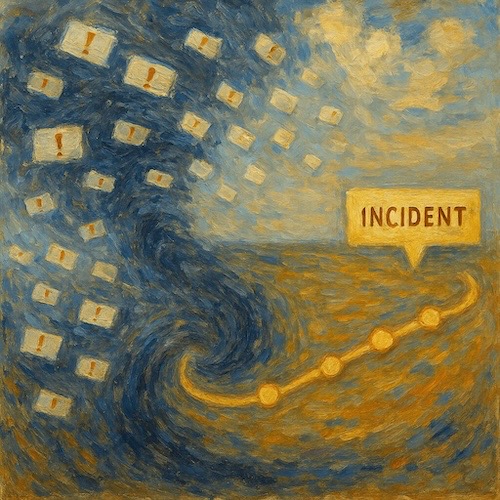
One database blip, thousands of identical alerts. Learn how deduplication keys and alert grouping turn alert storms into one actionable incident—and how All Quiet stays quiet until something truly new happens.

By Christine Feeney · Incident Management & SRE Technical Writer
Updated: Friday, June 26, 2026
Published: Friday, June 26, 2026
Modern alert routing & grouping features make incident response smoother by turning scattered system noise into high-context incident records your team can actually use. Instead of blasting engineers with every tiny signal, a smart incident management platform parses the payload meta data and turns it into unique deduplication keys. That means thousands of redundant metrics get compressed into one clear timeline. This kind of automated filtering stops cascading alert storms, cuts down mean time to acknowledgment (MTTA) and protects engineering teams from the burnout that comes with legacy, noise-heavy platforms.
Most engineers have had that incident. You know the one: A single database connection drops for a fraction of a second and your entire monitoring stack has a mental breakdown.
All it took was one tiny blip, one harmless little hiccup, one “Oops!” moment and suddenly your Slack channel was lighting up like a Christmas tree decorated with 46 sets of strip lights.
Alerts are pouring in from every angle, pods are complaining non-stop, services are having a panic attack and Prometheus scrapes only multiply the noise. Add to that your phone vibrating so hard it could walk itself home and you’ve got a recipe for the perfect engineer meltdown.
And then, you finally open your laptop and what do you see? Hundreds–if not thousands–of the exact same alert. Not similar, not related; identical. It’s the same ping multiplied by 10,000 across every instance, every retry loop, every health check and every microservice that so much as glanced at that database.
This is what’s called an alert storm and it’s the fastest way to dial your team’s cortisol levels up to 100. The thing is, the problem isn’t the incident itself but the multiplication of identical signals. And that’s exactly where deduplication comes into play for modern incident management platforms.
To understand deduplication, let’s have a look at how an alert storm happens.
The Anatomy of an Alert Storm
If you’ve ever been unlucky enough to witness a tornado in real life, you’ll know that they don’t just drop in out of nowhere to say hi. Quite the opposite: Everything is eerily silent, the wind freezes in time. They’re the very manifestation of the calm before the storm.
Alert storms don’t arrive with cinematic flair alongside dramatic music and flashing lights. They’re like tornadoes, creeping in quietly, almost politely, before wreaking havoc on the entire ecosystem. Which may make them even more maddening. After all, the only thing worse than chaos is predictable chaos that could’ve been prevented.
And it always starts with something small like a pod losing database connectivity for a split second; no biggie. In a perfect world the system would just shrug it off, reconnect and move on… but modern distributed systems don’t shrug, they react:
- The pod retries
- Then retries again
- Then retries again because the retry loop was written by someone who assumed that more retries must equal more reliability
- Each retry produces a log entry
- Each log entry matches an alerting rule
- Each alerting rule fires independently, blissfully unaware that 499 other pods are doing the same thing.
Meanwhile, Prometheus is chugging away, scraping metrics on its own schedule, turning up the noise volume by repeatedly evaluating the same failing condition over and over again. And because microservices are the rat kings of the tech world, one service’s hiccup becomes another one’s meltdown. Like co-dependent toddlers, one screams, they all scream. Downstream services start failing, upstream services panic and suddenly all the toys are being thrown out of the stroller.
By the time you’ve even sat at your desk with your lukewarm coffee and opened your laptop, you’re greeted with a wall of alerts that all point to the same root cause, just from slightly different angles, with slightly different labels and slightly different timestamps. It’s the engineering equivalent of the entire office giving you bad news until you’re no longer sure whether you’re sad or just numb.
But the really painful part? None of these alerts are wrong. They’re just… redundant.
They’re all doing their jobs by faithfully reporting symptoms of the same underlying issue but because alerting systems treat each signal as independent, you get flooded with alerts from every direction rather than just a concise, centralized summary. This is why SRE leads and platform engineers don’t just want fewer alerts; they want real alerts that represent unique events, not multiple versions of the same event.
Deduplication Keys: The Logic Behind the Silence
If alert storms are the wild gorillas, deduplication keys are the tranquilizers. They’re quiet, mathematical backbones of alert deduplication that decide which alerts are new information and which ones are just the system playing a broken record.
Deduplication keys are simple: They’re unique signatures built from the attributes of alerts, like the labels, metadata and identifiers that describe what actually happened. If two alerts share the same signature, they’re considered the same event, even when they differ slightly. But the real magic is in the engineering.
How a deduplication key is born
Every alert carries a payload: Service name, error code, hostname, pod name, namespace, timestamp, labels, annotations and whatever else your monitoring stack attaches. A deduplication key is made by hashing a chosen subset of those fields, i.e. the ones that matter for identifying the issue.
For example:
If 200 pods all report DB_CONNECTION_TIMEOUT, the deduplication key might be:
service + error_code
If a node goes down and every pod on that node alerts to it, the key might be:
node_name + error_type
If a Kubernetes deployment misbehaves, the key might be:
namespace + deployment + alert_name
The goal is straightforward:
Collapse identical alerts into one incident without losing the meaning behind them.
Why deduplication keys matter
It’s simple, really; without deduplication keys, your alerting system treats every alert as a unique snowflake. Whereas with them, it suppresses 1,000 identical signals to a single, actionable notification.
But it’s not suppression so much as signal compression, the same way a ZIP file takes a packed folder of data and turns it into something compact and usable.
Choosing the right fields
Now onto the fun part: The balance of art and science that is choosing which fields to include in a deduplication key. Too broad, you collapse unrelated issues into one incident. Too narrow and you still get flooded.
| Engineering Capability | Operational Mechanism | Key Platform Metric Impact | Core Strategic Value |
|---|---|---|---|
| Alert Deduplication | Turns key alert details into a unique signature so repeated instances of the error don’t keep firing | Signal Compression Ratio / Alert Volume Count | Cuts down repeated alerts that happen when services retry too fast or Prometheus scrapes too often |
| Alert Grouping | Clusters different signals (e.g., CPU, Memory, 504 latency drops) based on shared environment labels | Mean Time to Resolution (MTTR) | Pulls related infrastructure issues together so they show up as one clear incident instead of scattered signals |
SREs typically build keys around:
- Service identity (e.g.,
service,deployment,namespace) - Error identity (e.g.,
error_code,alert_name) - Infrastructure identity (e.g.,
node,pod,host) - Temporal windows (e.g., “treat all alerts within 30 seconds as one event”)
Prometheus users often rely on label sets, which makes this even more powerful (but also more dangerous if misconfigured).
Here’s a real example:
Imagine a service called checkout-api that suddenly can’t reach Redis. Every pod reports the same thing:
REDIS_TIMEOUT
service=checkout-api
error_code=504
Without deduplication, you get 50 alerts from different pods.
With a deduplication key like:
service + error_code
…you just get one. One incident, one page, one alert, one engineer responding and one team that doesn’t feel like their system is screaming at them from every possible angle.
The philosophy behind it is simply about respecting engineers’ attention. It makes sure that when your phone goes off, it’s because something new happened and not a million pods all shouting the same thing in unison.
Turning Symptoms Into a Story with Alert Grouping for Context
Alert grouping is a little more ambitious than deduplication. It builds a coherent narrative out of related signals. The truth is, most incidents don’t present themselves as one clean, tidy alert. They show up like a cluster headache with CPU spikes here, memory pressure there, a sudden rise in latency, maybe a pod eviction or two for dramatic effect. Individually, the alerts just look like noise, but together they describe exactly what’s going on.
Alert grouping is the mechanism that stitches all the symptoms together.
Why grouping is important
So, deduplication handles the “same alert, many times” problem.
Grouping handles the “many alerts, same problem” problem.
You’ll only have a fragmented view of your world without grouping:
- One alert says CPU is high
- Another says memory is low
- Another says latency is spiking
- Another says error rates are climbing
- Another says the pod is being evicted.
Technically all different alerts but they’re telling the same story.
How it works
Grouping relies on one shared attribute: The metadata that ties alerts together. In Kubernetes and Prometheus ecosystems, the metadata is gold: Labels, pod names, namespaces, node identities, service names, deployment names etc.
A grouping engine looks for patterns like:
- Same pod → CPU spike + memory pressure
- Same service → latency increase + error rate spike
- Same node → disk pressure + pod evictions
- Same deployment → rollout failure + crash loops
- Same namespace → cascading failures across related workloads.
When the engine sees the alerts firing within the same time frame, it clusters them into a single incident rather than the leaning tower of alerts.
Here’s a realistic example:
Let’s say your checkout-api service is having a rough day:
- First, CPU spikes
- Then memory usage climbs
- Then latency jumps
- Then error rates follow
- Then pods start restarting.
If you treat these as five separate alerts, you’re forcing an engineer to mentally find the pieces to the jigsaw while the system’s on fire.
Whereas if you group them, the engineer sees: “checkout-api is under resource pressure, causing latency and error rate spikes.”
This is the difference between “alerting” and “understanding.”
Prometheus alert grouping
Prometheus is the smart cushion of alert grouping. Users get an extra layer of power because labels provide super rich content. Grouping engines can cluster alerts by:
instancepodnodejobnamespacedeploymentservice- any custom label you’ve added.
Basically, you can group alerts by where and why it happened, instead of just what happened.
The All Quiet Solution
Now that we’ve walked through the storm, let’s sit in the eye for a bit.
All Quiet was built with a simple philosophy in mind: Alerts should be meaningful, not numerous.
Traditional systems behave like traditional alarms that ring every time a metric twitches. All Quiet builds this intelligence directly into the system background. Instead of routing raw static to your engineers, it functions as an automated incident management software engine that remains completely quiet until a unique architectural event requires human intervention. .
Here’s how it works.
Background deduplication engine
All Quiet continuously computes deduplication keys behind the scenes and collapses identical alerts instantly. No more DB timeout #437.
Contextual grouping
The system glues related alerts together into one incident storyline, rather than a fragmented frenzy.
Silent until it needs to shout
If something new isn’t happening, All Quiet stays quiet. If something changes, you’ll know about it. It’s that simple.
Prometheus-native intelligence
Labels, metadata and service relationships are all used to build smarter, cleaner, more accurate incident stories.
Burnout reduction
Unlike other incident management tools, All Quiet isn’t just about noise suppression but protecting the humans behind the screens.
All Quiet keeps your team’s notification stream beautifully and intentionally silent until a unique event occurs. It’s the kind of competent silence that justifies the tool’s very name.
From Chaos to Clarity
You may think alert storms are a sign of a failing system. And sometimes they might be. But mostly they’re just a sign that the system is talking too loudly in a hushed room.
Deduplication and grouping do a lot more than just reduce noise. They restore trust by turning your alert pipeline into a real signal and giving engineers the confidence that when something pings, it genuinely matters. They don’t need to worry about getting sprayed with a firehose of alerts.
And All Quiet takes that philosophy literally: Only notify when something truly new happens.
Everything else can sit in the background where it belongs.
Deduplication is for SRE Leads and Platform Engineers looking to mathematically suppress alerts storms and protect their teams from burnout. It’s a shift from chaos to clarity, noise to narrative, alarms to intelligence; and teams on the brink of meltdown to calm, collected engineers who aren’t overwhelmed and overtired.
If you’re looking for just that, talk to us today and see how we can fit into your tech stack.
Author
Incident Management & SRE Technical Writer
Technical writer focused on incident management and SRE; writes practical guides on on-call scheduling, integrations, and faster incident resolution, pairing technical depth with clear prose.
Recommended posts
-

Perspectives Christine Feeney
How PagerDuty Quietly Pushes Startups into Higher Price Tiers and Why it Feels Like an Enterprise Tax
Most startups start on PagerDuty's cheapest tier—until the renewal quote arrives and the numbers don't match the narrative. Here's why feature gates feel like an enterprise tax, and what transparent pricing looks like instead.
-
Product Guides & Tutorials Peer Rahne
Introduction to Advanced Incident Routing Rules in All Quiet
Learn what advanced routing rules are in All Quiet, how the default incident flow works, and how to set up your first workflow automation.
Read all blog posts and learn about what's happening at All Quiet.
Published