


Perspectives
How PagerDuty Quietly Pushes Startups into Higher Price Tiers and Why it Feels Like an Enterprise Tax
Quick answer
Modern incident management platforms help teams avoid the hidden costs that make PagerDuty renewals so painful. Instead of locking essential controls behind enterprise-tier pricing, leaner systems treat payload metadata, routing logic and deduplication as baseline features. They prevent the repeated signals that push teams into higher PagerDuty tiers by turning noisy alerts into structured incident records. The noise-aware design keeps MTTA low, reduces alert fatigue and protects startups from the "enterprise tax," offering predictable pricing that scales with responders, not feature gates.
Most startups start on PagerDuty's cheapest tier—until the renewal quote arrives and the numbers don't match the narrative. Here's why feature gates feel like an enterprise tax, and what transparent pricing looks like instead.

By Christine Feeney · Incident Management & SRE Technical Writer

Reviewed by Maximilian Beller · Co-Founder & CTO at All Quiet
Updated: Tuesday, October 13, 2026
Published: Monday, June 29, 2026
Most growing startups tell themselves the same story about tooling: "We'll start on the free (or cheapest) tier and pay a bit more when we grow. Fair enough." And that story always starts off like a fairy tale, until the renewal email arrives and the numbers don't match the narrative.
Instead of a smooth, gentle step up in price, the CFO finds themself looking at what can only be described as a mortgage quote rather than a reasonable SaaS bill, while the CTO methodically evaluates each line item trying to understand what changed: did the team suddenly become a Fortune 500? How did cleaning up our alerts turn into buying AI ops?
And so begins the late night Googling spiral:
- PagerDuty pricing for startups
- PagerDuty pricing tiers
- PagerDuty hidden costs
- PagerDuty alternatives
- Am I being punked?
The team doesn't hate PagerDuty all of a sudden; it's just that the relationship doesn't feel proportional anymore. They've worked hard to build operational maturity with more services, responders, structure; and now the pricing feels like it belongs to a different kind of company.
That disconnect is the core of the problem and it's where an "enterprise tax" starts to feel less like a hallucination.
When the enterprise tax suddenly gets steeper
Since October 2026, PagerDuty's pricing is a staircase with a gap in the middle: Free, then Professional at $21 per user per month, then the PD Reliability Platform at $2,800 per year for 10 seats (Starter), $12,000 per year for 20 seats (Essential) and $48,000 per year for 50 seats (Plus). Starter and Essential have the same features; the step between them buys 10 more seats for 4.3 times the price. The first few steps are shallow, approachable; especially for smaller, early-stage teams. They give you enough to be safe and responsive, to feel like you're doing incident management "properly." But somewhere in between "we added a few more services" and "we're fine tuning how we handle our payloads," that staircase suddenly turned into a cliff edge.
It's one of those cliffs that appears when you think you're climbing the mountain skillfully; you even got a new pair of hiking boots. But right when the team tries to do something that feels entirely reasonable for a growing startup, like adjusting payload mapping so alerts are less noisy and more structured, or routing incidents differently based on severity or service, or even experimenting with automation or smarter deduplication; that's when sh*t hits the fan.
None of these wants are fancy or extravagant—if anything, they're the natural next steps of a scaling startup. It's perfectly expected that teams will start testing the waters of new projects as they grow. Yet, in PagerDuty's world, many of these steps fall under the "Professional" or "Enterprise" umbrellas. They're often bundled with AI Ops and advanced features with pricing for companies with budgets that match PagerDuty's complexity, not your average startup or quickly growing scaleup that suddenly doubled in size overnight.
You end up with what feels like an enterprise tax; you're not paying more because you need a wider range of AI-driven capabilities, you just need the basic knobs and levers of incident management that PagerDuty's packaged up in fancy higher tiers. The free and lower tier plans are great until you want real control, and once you want that, you're told you're now an "enterprise customer," whether your headcount agrees or not (and PagerDuty doesn't care that you've been working from your home garage for the last year and a half).
In other words, you're being punished for your success. Sucks, right?
Feature bloat vs. core reliability: what startups really need
Let's bring it back to basics. Strip away the marketing language and feature grids and you'll see that most startups share a remarkably consistent, and stunningly simple, set of needs when it comes to incident management:
- Easy to maintain on-call schedules that don't require a long-winded handover and a ritual sacrifice
- Reliable routing so incidents reach the right person or team without turning into a Slack version of Russian roulette
- Tight Slack integration because that's where their real-time collaboration lives
- Basic alert deduplication to avoid being serenaded with a Shakespearean soliloquy, performed by an alert system that doesn't know how to speak plain English.
What they don't need (at least not yet) is a sprawling network of AI Ops, advanced analytics dashboards, fancy event intelligence pipelines and all the bells and whistles that assume a complex organizational structure they simply don't have.
But when they cross a certain threshold with PagerDuty, that's exactly what they're paying for. The pricing tiers don't care about what type of company they are so much as how many of PD's configuration options they've touched.
This is exactly where feature bloat becomes more of a financial issue than mere UX annoyance. The growing company is expected to effectively subsidize a product roadmap built for much larger organizations and pay for capabilities they might never even use just to unlock a few controls they genuinely need. It's the operational equivalent of being handed a junk drawer, complete with five-year old batteries, mystery cables and half-empty tubes of lotion, and being told you have to keep the whole thing because one item in there might be useful some day.
From a CFO's point of view, it's the opposite of good incident management software ROI. The cost curve bends upwards faster than the value curve and the justification starts to feel wafer thin.
The psychology of sticker shock and why it hurts more than other SaaS increases
Sticker shock is all about the story behind the price tag. When a CRM or analytics tool ups its prices, teams often rationalize it away with "We're using it more, we've grown, it's only fair." But the emotional stakes are different with incident management—the system that protects uptime, customer trust, internal sanity... It's meant to be the quiet backbone, not the loudest line item.
For the finance team though, the shock all comes from the loss of predictability. When the trajectory is understandable, i.e more engineers, more services, more cost, there's no problem. Instead, they've crossed an invisible line by adding more schedules, needing more granular routing, wanting better payload handling, and now the tier jump feels disproportionate. They didn't actively choose to "go enterprise;" they just wanted to make their incident process less chaotic.
It feels like a misalignment between technical maturity and financial reality: The better they run operations, the more they're punished by higher prices.
And this is what's driving so many teams to look for alternative tools. They're sick of the surprise, misalignment and frankly, unfairness of forced escalation.
The bootstrapped equation and how All Quiet breaks the pricing trap
All Quiet was built with a different equation in mind. One that bootstrapped founders, CFOs and CTOs can explain in a simple conversation. All Quiet doesn't hide core controls behind enterprise labels but treats those controls as basic necessities. On-call schedules, reliable routing, Slack-native workflows and flexible payload handling are just part of the bargain. They're not premium features that you have to sell your car to afford; they're just the baseline of incident management.
While PagerDuty nudges you towards a higher pricing tier, All Quiet's model gives you the same power without shoving you into a different pricing category. You don't just wake up one day and wonder how your company made an extra few million overnight. You don't abruptly realize that adjusting how alerts are grouped or routed now requires an AI bundle. You don't find yourself paying for automation frameworks you never asked for just because you wanted some peace and quiet.
You don't get any of that because All Quiet's pricing is designed as a catalyst for startup growth; you can turn a handful of engineers into a proper team without crossing a psychological or financial chasm. Financially, this matters: incident management software ROI should improve as your ops mature. With All Quiet holding the reins, the cost:value relationship is linear and clear: more responders, more incidents handled, more uptime, same transparent pricing.
A quiet look at ROI and the numbers that actually matter
| Scenario | PagerDuty | All Quiet | What this means for you |
|---|---|---|---|
| 10 responders who need alert grouping | Professional + AIOps add-on: $10,908/year, or Platform Starter: $2,800/year (annual, upfront) | Standard: $599/year | Noise reduction is an add-on or a platform tier on PagerDuty and part of the base plan on All Quiet. |
| Team grows from 10 to 20 responders | Starter to Essential: $2,800 to $12,000/year, plus required Expert Services | Standard: $599 to $1,198/year | All Quiet scales per user; PagerDuty scales in steps. |
| Payload mapping and field extraction | AIOps add-on on Professional (from $699/month), included from Platform Starter | Included on every plan | A single configuration need can move you up a tier on PagerDuty. |
| A second on-call schedule | Needs Professional (Free has 1 schedule) | Included | |
| Read-only stakeholders | Count as seats on the Platform; sold separately on Professional | Not billed if they are not members of a team | |
| 15 responders, with alert grouping | Professional + AIOps: about $12,168/year, or Essential: $12,000/year plus Expert Services | Standard: $898/year, Pro: $1,798/year |
PagerDuty prices from pagerduty.com/pricing, checked 13 October 2026. All Quiet prices are the US list prices; EU-region prices are 6,99 € and 11,99 € per user per month.
Focusing purely on numbers makes the picture a bit less murky. PagerDuty's tiered model means your cost per responder, per incident or per routing rule can shoot up the second you cross a plan boundary, even if your actual usage hasn't changed much.
For example:
A team with eight engineers on the Team plan pays roughly $25 per user/month. They need features locked behind the Professional tier, so they're now paying $39 per user/month.
Similarly, if you add ten responders, you're somehow now paying $4,680 extra per year without having increased your incident volume or complexity. In essence, you're paying for the right to exist in a higher category, not for a proportional increase in value. The maths changed but your needs didn't, so now you're left wondering why you didn't pay more attention during the 18 demos you attended while searching for the right tool.
All Quiet's approach keeps the maths boring
...in the best possible way. Their cost structure is predictable and what you pay versus what you get is easy to understand. If a team handles 20-30 incidents per month, the cost doesn't double overnight because they added a second on-call rotation or created a new routing rule.
You can look at the bill and tie it back to operational outcomes without wondering how you somehow spent an extra $3k. You don't have to explain why half the line items refer to features the team has never even used or why a simple payload adjustment triggered a 30-50% increase in annual spend.
Over time, predictability is value. You're not just buying any old incident management tool but the ability to play around with it, without needing a separate spreadsheet just in case you add one more schedule. If you grow from 15 to 50 engineers, the cost scales in a straight line, not a staircase with a cliff edge halfway through. And that quiet, linear predictability is worth more than any AI-powered feature you didn't ask for.
A different kind of ending
Your team eventually reaches a point with PagerDuty where the numbers and the narrative simply don't match anymore (could this be contributing to their stock drop?). You'll have grown, but not into an enterprise; you'll have matured, but not into a company that needs a full AI Ops stack; you'll want control, clarity and calm, but after comparing the best PagerDuty alternatives, you'll move to All Quiet.
You now know what real relief feels like. Your CFO stops looking at the incident management invoice like a volatile asset and the CTO doesn't need to worry that every routing improvement or payload handling will trigger an awkward pricing conversation. Incidents still happen (this is software, after all) but managing them no longer feels like a luxury product.
The most noticeable change is the tone of the conversations around reliability. They're calmer, more focused. They're less defensive and incident management goes back to what it should have been all along: a quiet, dependable part of the stack.
Run your own PagerDuty ROI check
If you're somewhere along this same journey, whether that's starting a renewal quote or wondering when you supposedly became "enterprise" level, it's worth running your own numbers: Check them out here.
You can look at what you're actually using, what you need and how much of your bill is tied to features that exist in marketing decks. Plus, you can enter how many users you need and see PagerDuty's prices vs All Quiet's (it's a big difference).
You don't have to accept the enterprise tax as gospel. It's not a consequence of growth, you're just using the wrong tool. And sometimes you have to walk away from a tool whose pricing model no longer suits you.
If you want to talk to us about how we can do everything PagerDuty can, and more, get in touch.
Sources checked
- Plans & Pricing, PagerDuty, checked 13 October 2026: plans, prices, seats, events, add-ons and plan features
- AIOps Pricing, PagerDuty, checked 13 October 2026: AIOps from $699 per month, PagerDuty Advance from $415 per month, accepted-event definition
- All Quiet Pricing, All Quiet, checked 13 October 2026: Standard and Pro prices and plan features, EU-region prices
- Billing & Subscription, All Quiet documentation, checked 13 October 2026: users are billed by team membership
Author
Incident Management & SRE Technical Writer
Technical writer focused on incident management and SRE; writes practical guides on on-call scheduling, integrations, and faster incident resolution, pairing technical depth with clear prose.
Reviewer
Co-Founder & CTO at All Quiet
Engineering leader building incident management systems focused on reliability, clear escalation, and sustainable on-call operations for production teams.
Recommended posts
-

Status Pages Nikolas Köppl
Best Status Page Service for Engineering Teams in 2026
Most status page comparisons miss the point. Engineering teams need status pages wired into incident workflows—not standalone tools you update manually during a firefight.
-
Perspectives Christine Feeney
How Alert Routing & Grouping Power Lean Incident Management Platforms
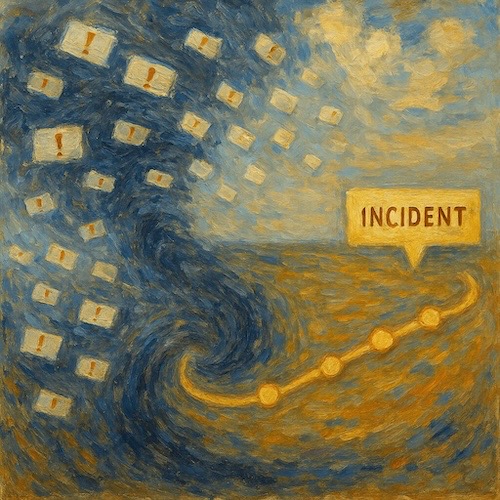
One database blip, thousands of identical alerts. Learn how deduplication keys and alert grouping turn alert storms into one actionable incident—and how All Quiet stays quiet until something truly new happens.
Read all blog posts and learn about what's happening at All Quiet.
Published · Updated