


Perspectives
Understanding the Incident Management Software & On-Call Lifecycle
Quick answer
The difference between on-call, incident response and incident management really comes down to the role each one plays in the reliability lifecycle. On-call is the logistics layer that makes sure the right developers are available when something breaks. Incident response is the real-time tactical work: the triage, the automation and the communication needed to restore service quickly. Incident management sits above both. It's the strategic process of digging into root causes, understanding why the failure happened and changing system architecture so it doesn't happen again. Together, these three layers form the backbone of modern reliability operations. One handles availability, one handles action and one handles long-term improvement.
On-call, incident response, and incident management are three different stages of the reliability lifecycle. This guide maps the SRE Trinity from first alert to long-term improvement.

By Christine Feeney · Incident Management & SRE Technical Writer
Updated: Tuesday, June 16, 2026
Published: Tuesday, June 16, 2026
Spend enough time in DevOps and you'll hear terms like on-call, incident response and incident management thrown around like hot potatoes. Stay there long enough and you'll learn that they're all just different ways of saying "something went wrong."
They all orbit the same realm of chaos but where many companies go wrong is treating them as synonyms. They end up with alert fatigue, confused responsibilities, processes that feel like they were designed by someone in a coma and a team of engineers wishing they were.
The truth is simple: On-call, incident response and incident management are three completely different stages of the incident lifecycle.
Three different jobs, three different mindsets.
Together, they form the dream team: The SRE Trinity. In other words, the backbone of reliability work. And once you understand the differences, the whole world of incident handling suddenly makes a lot more sense.
We've put together this guide as your map through the lifecycle of a crisis, from the moment someone gets a tap on the shoulder to the moment your entire team breathes a collective sigh of relief.
The Three Pillars of Reliability
Let's start with the big picture. Firstly, reliability isn't one job–it's three. And secondly, they all solve a very different kind of problem.
On-call = A resource problem
The "who's available?" stage that relies on logistics over heroics.
Incident response = A tactical problem
The "what broke and how do we stop it from breaking more?" stage.
Incident management = A structural problem
The "why did this happen and how do we prevent it?" stage.
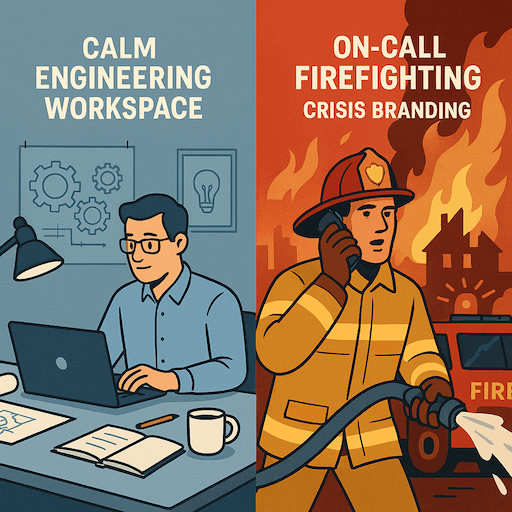
To put it simply, let's take a leaf out of the Firefighter Analogy's book:
- On-call is the firefighter waiting at the station.
- Incident response is the firefighter running into the burning building.
- Incident management is the fire marshal redesigning the city so fewer buildings burn down.
In short: Fewer fires, more calm.
The Main Acts
Here's a glance at the three pillars and their core functions.
| Pillar | Goal | Primary tooling | Success metric |
|---|---|---|---|
| On-Call | Ensure 24/7 coverage | Schedules, rotations, escalation policies | Fast acknowledgement (MTTA) |
| Incident Response | Restore service quickly | Slack workflows, automation, alert routing | Low MTTR |
| Incident Management | Improve long-term reliability | RCA tools, post-incident reviews, runbooks | Fewer repeat incidents |
Now, let's dive in.
-
On-call: The Duty of Coverage
Let's start with the firefighter.
He's waiting at the station at 2 a.m, ready to go. He's quiet, slightly tense; there's a background hum of reliability and an undercurrent of repressed panic. He's the physical embodiment of human readiness: Making sure someone is available, prepared and not learning how to slide down the fireman's pole for the first time.
And that's on-call. Yes, it's about solving the incident but more importantly, it's about being there. It's the operational equivalent of "tag, you're up."
What actually is on-call?
On-call is the machinery behind the scenes: The schedules, rotations, escalation paths, the subtle art of making sure the same person isn't "accidentally" on every holiday or weekend shift. On-call is the system that makes sure someone is always around, without being sacrificial.
It's also where you'll find the "pagers with better CSS" category of tools. You know, the on-call management software that look modern but don't actually do much beyond screaming "something happened!" into the void in a slightly prettier font?
The job to be done
On-call answers one basic question: "Who's picking up the alert?"
Not "who's fixing it?" or "who's writing the post-incident review?"
Just who answers first.
Why it matters
Most DevOps teams understand the accountability struggle that is: Whose job is it to fix this problem and why is the same person either doing nothing or everything all at once?
Because without clear ownership, everything implodes. If no one knows who's supposed to respond, incidents become group projects (which we can all agree absolutely suck) and if those didn't work in school, they definitely won't work now.
Think of on-call as the foundation of the house. It's the building block that everything else is constructed upon. But the real drama starts when the alert actually fires.
-
Incident Response: The Art of Triage
So, on-call is the quiet readiness phase, which makes incident response the moment the universe knocks on your door saying "hey, something happened, deal with it." It's the very instant an alert fires and the whole system goes from passive monitoring to active coordination. The next few minutes determine whether this becomes a small kitchen mishap or a full-blown house fire.
Incident response workflows are the tactical heart of the incident lifecycle where automation comes to life, Slack channels materialise out of thin air and escalation paths light up like a Christmas tree. Teams suddenly know exactly what they're doing and everyone works together like a well-oiled machine.
But to understand why this stage is so critical, you first need to understand how it works.
The "first 15 minutes" rule
The D-Day of incident response is the first 15 minutes after an alert fires. It's a time where the team is still figuring out what's real, what's noise and what's a hallucination. It's also when the most time is wasted if the process isn't watertight.
Which is exactly why modern incident tooling leans so heavily on automation. Teams evaluating PagerDuty against leaner stacks should also read our roundup of PagerDuty alternatives for SRE teams. The second an alert triggers, your system should:
- Loop the right people in automatically
- Post the relevant dashboards, logs and recent deploys
- Assign the initial roles
- Set the tone for structured communication through Status Pages and the right collaboration platforms.
Having your humans do this manually is just flushing precious minutes down the toilet while MTTR quietly climbs in the background.
It's simple: Structure early or chaos will structure itself.
The backbone of fast response
Automated escalations are the unsung heroes of incident response. They hum away in the background making sure the right people are brought in at the right time without anyone having to ask for it. A good system routes responsibility, not just people, and understands severity, service ownership, time of day and fallback paths–the perfect companion.
Automated escalations know exactly when to escalate and when to wait, separating modern incident response from the "pagers with better CSS." They're decision engines that, when they work well, reduce MTTR dramatically by looping in the right expertise immediately.
Tool-native collaboration
There's no two ways about it: Incident response happens in Slack or Teams now. No emails or tickets, no dashboards or confusion; the collaboration tool is the command center, the coordination layer, the shared brain.
A tool-native workflow means:
- The alert fires → the channel appears
- The channel appears → the team assembles
- The team assembles → context is ready and waiting for them.
No one needs to go on a witch hunt for dashboards or wonder where the thread is. The collab tool is the single source of truth for the entire response. It's where the hypotheses are tested and updates are posted and ultimately, where decisions are made. Plus, it keeps everyone aligned on their responsibilities. What more could you want?
Responders vs commanders
When the alert fires, two things happens:
- Responders dive into the technical investigation
- Commanders orchestrate the response.
The distinction is essential and is what keeps things moving in an orderly fashion. A responder who's deep in the trenches of logs shouldn't be responsible for writing updates, while a commander shouldn't be juggling other tasks while coordinating five people.
The division of labor is what keeps MTTR low by preventing work duplication, missed signals and the classic "three people debugging the same thing" conundrum.
Decision-making under uncertainty
Incident response is by no means flawless. It's full of imperfect information. You rarely have the full picture and waiting for clarity is a luxury you can't have (and likely can't afford). This is where structured decision-making comes in:
- What do we know?
- What do we suspect?
- What's the safe next step?
- What's the fastest reversible action?
Teams that embrace reversible decisions move faster and break fewer things, so they have less to fix in the long run. But waste time waiting around for certainty and you're prolonging incidents for no reason.
-
Incident Management: The Strategy of Reliability
Incident response = the frantic scramble to stabilize the system.
Incident management = the deep exhale of relief that comes afterwards.Think of modern incident management software as the reflective, strategic, slightly philosophical stage of the lifecycle. If you're lost in the woods, it's the long, meandering walk back through the forest where you retrace your steps, follow the breadcrumbs and realize exactly where you took a wrong turn.
Incident management is slower, more introspective, calmer… But don't let it fool you. This is where the real reliability work happens.
What it actually is
Incident management is where teams stop reacting and start learning. It's the home of the post-mortem, the structured, honest and occasionally humbling ritual that lays out the timeline, examines the decisions and figures out why the system behaved the way it did.
This is where Root Cause Analysis (RCA) happens, not as a witch hunt, but as a methodical exploration of all contributing factors. And it's also where you hone in on the systemic issues that quietly set the stage long before the alert ever fired.
Incident management is more about architecture than firefighting; it lets you redesign the whole stage so the same showstopper doesn't happen again. You're no longer patching up symptoms and hoping for the best, but fixing the underlying conditions that led to the incident in the first place.
Why it matters
Incident response without incident management is like shoveling coal into a train engine without checking if there are even tracks ahead. Without incident management, you're in survival mode; and that's not a strategy. It's barely even a plan.
Some teams skip this stage and inevitably end up in a perpetual loop of déjà vu incidents: The same thing breaks, the same alert fires, the same Slack channel fills with the same messages, the same people try to fix the same problem. It's monotony on loop.
But teams that embrace this stage evolve by building systems that learn from failure instead of repeating it. They construct cultures of honesty and they make it normal! Blame is unnecessary and improvement is continuous when reliability is a philosophy rather than a reaction.
In short: Incident management is where teams grow, not just systems.
The philosophy of Incident Management
Blameless culture
A blameless post-mortem culture doesn't pretend mistakes didn't happen (but oh, if it could). It acknowledges that humans are predictable and systems are complex, and it understands that pointing the finger doesn't fix the architecture. When blamelessness is added to the mix, it creates psychological safety, which creates honesty, which creates better data, which creates better systems. It's a chain reaction of improvement.
Root Cause Analysis (RCA)
Let's be honest, there's rarely just one root cause (psst! This is what a thorough root cause analysis uncovers). What was misconfigured? What was assumed? What guardrails were missing? It's the "temporary" workaround from 2021 that somehow stuck because it's actually good. It works. It reveals how the system really behaves, not how you thought it behaved.
Reliability as a system
You can't get reliability by reacting quickly. It's a slow-burn that's built by designing systems that fail gracefully, recover predictably and teach you something every time their training wheels wobble.
The on-call lifecycle
Incident management closes the loop that on-call opens:
On-call catches the problem
↓
Incident response stabilizes it
↓
Incident management prevents it.It's a not-so-vicious cycle that keeps the cycle from becoming a downward spiral.
When you're deciding on a platform, start with our ranking of the top incident management solutions.
The Calm After the Storm
If the SRE Trinity teaches us anything, it's that reliability is a whole ecosystem of people, processes and philosophy working together. On-call gives you coverage, incident response gives you control and incident management gives you clarity. When it works well, it's all one big happy family out for ice cream on a hot day. Miss any one of them and your ice cream is already a pool of liquid in a soggy cone.
With the three pillars working in harmony, incidents stop feeling like existential threats and start feeling like opportunities to learn, improve, tighten the bolts and strengthen the foundations. You can let the firefighter take a nap in the station and start city-building. You can stop surviving and start engineering.
And that's the whole point, really. Reliability isn't a reaction, but a practice. It's a mindset, a culture, a loop that tightens and gets smarter every time you run it.
If you want a platform that actually supports that philosophy and treats on-call, incident response and incident management as a unified lifecycle instead of three disconnected chores, then it might be time to see what All Quiet looks like in action.
Explore how we can bring the entire SRE Trinity to your doorstep in one beautifully simple workflow.
Author
Incident Management & SRE Technical Writer
Technical writer focused on incident management and SRE; writes practical guides on on-call scheduling, integrations, and faster incident resolution, pairing technical depth with clear prose.
Recommended posts
-

Perspectives Christine Feeney
How to Set Up Follow-the-Sun On-Call
Spread on-call across APAC, EMEA, and AMER so no one works nights. This guide covers time-zone handoffs, DST traps, and automated rotations that keep coverage humane.
-
Perspectives Nikolas Köppl
Why Is the On-Call Industry So Obsessed with Fire?
The phone rings at 3:14 AM. It's a flapping CPU alert, not a meltdown. Why does on-call tooling glorify fire, duty, and incidents instead of prevention and quiet?
Read all blog posts and learn about what's happening at All Quiet.
Published