

Perspectives
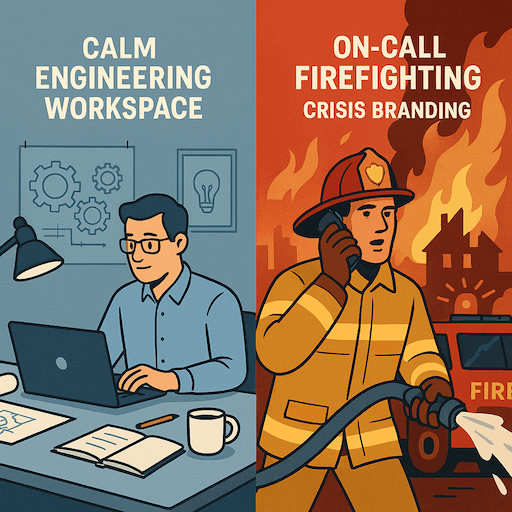
Why Is the On-Call Industry So Obsessed with Fire?
The phone rings at 3:14 AM. It's a flapping CPU alert, not a meltdown. Why does on-call tooling glorify fire, duty, and incidents instead of prevention and quiet?

By Nikolas Köppl · Go-to-market at All Quiet
Updated: Tuesday, June 9, 2026
Published: Tuesday, June 9, 2026
When we started All Quiet, we found Incident management as a fundamentally broken experience — and integrating resilient, automated on-call management software prevents infrastructure fatigue from being marketed as the only way to run rotations.
The phone rings at 3:14 AM. You jump out of bed, your heart rate spiking. You scramble to your laptop, eyes blurring in the dark, no time to grab a coffee to get your brain into focus mode. Muscle memory kicks in. You log in, braced for disaster.
Then comes the "you've got to be kidding me" moment.
It's not a data center meltdown. It's just a flapping alert because a non-critical microservice momentarily checked a CPU utilization box from 35% to 36%. Your sleep is ruined over background noise.
Because on-call is universally dreaded, the incumbents in this space have built entire brands around the crisis itself. Why beat around the bush when everyone knows being on-call is the worst week of your month? The right on-call software should protect your sleep, not market the crisis.
Look at how they name themselves:
- PagerDuty, the legacy giant, puts the emphasis squarely on the historical trauma of the physical pager and the grueling, mandatory "duty" that comes with it.
- incident.io, the modern Slack-native tool, makes the "incident" the singular, inescapable focus of its identity.
- FireHydrant leans entirely into the "everything is burning, grab the hose" mentality. It forces a constant state of artificial high alert. When your tooling is named after firefighting equipment, it's no wonder your engineering team burns out.
Things will break. That's the reality of shipping features five hours after your last deployment. We get it, and nobody is slacking when a true SEV-1 puts your SLA in danger.
But modern incident management has a structural flaw: it glorifies the fire instead of the prevention. It treats engineering teams like reactive firefighters rather than proactive architects.
We can't speak for everyone, but our customers are keen to only page when the house is actually burning down, not when the toaster is just doing its job. They want a platform that filters out the background radiation of minor logs so they can protect their sleep for true, system-critical anomalies.
We think the industry has it backward. Why build a brand around the chaos? Why celebrate the "Duty," obsess over the "Incident," or worship the "Fire"?
At All Quiet, we named our platform after the outcome, not the crisis.
We believe incident management shouldn't be about managing the flames; it should be about protecting the silence. Your default engineering state should be a confident, uninterrupted quiet. When your alerting pipelines are finely tuned, and your UI is built by and for SREs who actually understand signal-to-noise ratios, you stop sleeping with one eye open.
We aren't here to hand you a heavier hydrant or remind you of your corporate duty. We're here to give you your nights back. Because the ultimate flex in DevOps isn't how fast you put out a fire, it's how quiet you can keep the system.
If you arrived here through my LinkedIn post about our accidental battle with Hollywood over search rankings, don't worry, we have absolutely nothing to do with Remarque's World War I masterpiece. We just happen to believe that the best days on call are the ones where nothing happens at all.
Ready for some peace and quiet? Sign up for a free trial or book a quick, no-BS chat here.
Author
Go-to-market at All Quiet
Builds go-to-market and customer-first growth for teams adopting calmer, clearer incident communication.
Recommended posts
-

Perspectives Christine Feeney
Understanding the Incident Management Software & On-Call Lifecycle
On-call, incident response, and incident management are three different stages of the reliability lifecycle. This guide maps the SRE Trinity from first alert to long-term improvement.
-

Perspectives Peer Rahne
Why We Built Live Call Routing the Lean Way
When email is not enough, you need a human on the phone. Live Call Routing should not require a sales cycle or telephony markup. Here is how All Quiet built it the lean way.
Read all blog posts and learn about what's happening at All Quiet.
Published