

Perspectives
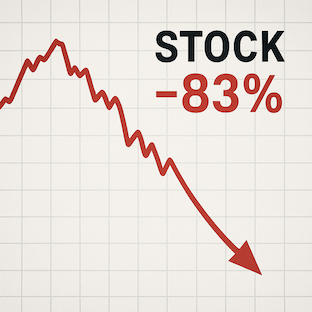
PagerDuty’s 83% Stock Drop Since 2019 and What We Learned from It in 2026
There’s nothing like a good old fashioned budget review to remind you what you’re actually spending money on… and how much of it.

By Christine Feeney · Incident Management & SRE Technical Writer

Reviewed by Maximilian Beller · Co-Founder & CTO at All Quiet
Updated: Tuesday, October 13, 2026
Published: Monday, May 4, 2026
Editor's note, October 2026: PagerDuty has since changed its pricing. It removed its Business and Enterprise plans and introduced the PD Reliability Platform. For current prices, see PagerDuty Pricing Explained.
PagerDuty’s 83% Stock Drop Since 2019 and What We Learned from It in 2026
There’s nothing like a good old fashioned budget review to remind you what you’re actually spending money on… and how much of it.
PagerDuty is one of those tools that makes you do a double-take when you open the invoice. You ask yourself: “Is this the monthly or the annual figure?” while wondering if either would even be acceptable.
This collective eyebrow raise isn’t because PagerDuty is bad software, but because the world around it changed while PagerDuty stayed the same.
To understand what happened, you have to look at the bigger picture; the world around PagerDuty that evolved while it remained static. Let’s see how their story unfolds.
Act I: Setting the scene
PagerDuty IPO’d in 2019 and by 2021 it was trading around $34. It came onto the scene like the big brother of incident response, knowing it had nailed a problem that everyone else was either ignoring or still trying to solve. PagerDuty was reliable; the kind of tool you bought to show off that you had your operational act together.
Fast-forward to 2025/2026 and it’s suffered a multi-year collapse with a 73% decline over 5 years. For a while, the market was all about PagerDuty, but then it did what it normally does: it changed its mind.
In November 2025, PagerDuty’s stock plummeted 24% in a single day. Their team had waved a small victory flag while publishing their Q3 results with GAAP profitability for the second straight quarter, which was great news! Until they pulled back their revenue guidance because of customers cutting seats and watching their budgets.
Sure, the financial housekeeping seemed cleaner, as their margins were improving on the surface and EPS was behaving as it should. But then the curtain was drawn: they lowered their growth expectations and analysts went straight for the jugular. Suddenly, everyone was wondering whether PagerDuty could even keep its revenue engine running at the pace Wall Street expected.
If your on-call alerts dropped this hard, you’d file an incident report.
Act II: Enterprise pricing in a market that’s lost confidence
I don’t want to sugar-coat it. PagerDuty’s pricing has always been aspirational. They’ve positioned themselves as enterprise-grade, while CTOs increasingly see them as enterprise-inflated. It’s the kind of pricing that assumes you have a huge team, an even bigger budget and an extremely forgiving CFO (or one who’s asleep on the job). If you’re comparing options, start with our roundup of the top PagerDuty alternatives in 2026.
This approach worked for years, though. Enterprise pricing was part of the deal for DevOps starter packs, but then the pendulum swung. Seat-based pricing is now under more pressure than ever before. Analysts even said that seat license compression and slowing ARR growth were key factors in PagerDuty’s revenue slowdown.
In other words, customers were trimming their usage rather than expanding it. But why do that when you can let the system take care of the groundwork for you? A huge amount of alert handling is just repetition: checking if the alert is real, gathering context, matching it to other signals, rinse and repeat. But a solid system can filter out the junk and enrich alerts with the right information, then connect related events and trigger the fixes. You instantly cut down on noise, along with 70% of security investigations.
You can’t replace your analyst, but you absolutely can clear the fog so they can focus on alerts that matter.
Act III: Do you really need the Cadillac?
While PagerDuty was busy expanding its platform, modern alternatives were slowly creeping up on it with better open-source tools, more mature cloud providers and bootstrapped SaaS tools. Suddenly, you could get 80-90% of PagerDuty’s core functionality without paying enterprise prices.
This wasn’t a symptom of PagerDuty being copied by competitors, but incident response itself becoming a solved problem. Cloud-native alerting like AWS, GCP and Azure had matured dramatically, while open-source tools like Alertmanager continued to get better and better. They were offering alerting pipelines that, five years ago, would’ve looked like something from Futurama.
Incident response suddenly had flat pricing, transparent billing, no per-seat penalties and support teams that actually answered emails. Meanwhile, PagerDuty was still innovating. They rolled out AI-driven automation and workflow orchestrations, and even reported that 825 customers were spending $100k+ ARR in Q3 2024.
But does innovation erase the pricing gap for lean teams?
Big, fat no. And that’s when migrations start to happen.
Act IV: The not-so-quiet migration
If you want to really understand the shift in the market, go to the belly of the beast. Look at Slack channels, look at Reddit threads–go to the very places where engineers actually tell the truth. You’ll see common themes emerging in the DevOps community and messages like:
- “We switched and nothing broke.”
- “We were paying for features we never used.”
- “We were punished with higher prices for growing.”
- “We replaced it with a lightweight SaaS and cloud-native tool.”
The reality is that companies weren’t fighting back or even arguing with PagerDuty. They simply… moved on. They realized that they, in fact, didn’t need the Cadillac. They turned away from longer sales cycles and SMB-weakness, towards cheaper software that worked well and didn’t require a whole board meeting to approve.
Act V: The lean, mean, incident response machines
Call the news stations, everyone; the bootstrapped competitors are having their moment in the sun. Incident response is entering a new era and the winners aren’t the biggest, shiniest platforms with features pouring out of the box. They’re the ones offering:
- Flat pricing
- Transparent billing
- Faster support
- No need to justify their existence every fiscal year
- Alignment with modern engineering teams
- No pressure to satisfy Wall Street.
PagerDuty’s 52-week low of $13.94 in 2025, a 34.67% YoY drop, wasn’t a failure, but a sign of customer and investor uncertainty. It proved that the old model of “enterprise pricing for everyone” simply wasn’t the go-to anymore. And unless companies are willing to evolve in line with that reality, they’ll fade into the background of those that thrive in the next decade.
Final act: What this means for the future of incident response
The incident response market is going through a big personality change. It’s moving from enterprise-first to developer-first, with big platforms, big bundles and big invoices. PagerDuty is a case study in what happens when pricing strategy diverges from customer value. If the bill keeps climbing but the value doesn’t, customers won’t bother complaining about it. They’ll just leave.
And here’s the twist: even though multiple DCF analyses suggest PagerDuty is undervalued by 50-55%, investors still question its growth prospects. The future of incident response will be defined by tools that don’t overcharge or overcomplicate, and simply do what they say they’ll do without making you expense a limb.
So are you paying for product or public market overhead?
An 82.8% stock-drop isn’t something investors will bat their eyelids at. A fall that hard forces customers to rethink what they’re actually paying for: the product? The innovation? The reliability? Or just the cost of being a public company with slowing growth and rising pressure?
And not just customers, but CTOs too. They’re evaluating whether they’re using the features they pay for and if the pricing model makes sense for how their teams work today. They want to know if the vendor is stable enough to bet their operations on and what the ROI is compared to the alternatives (or just building it themselves).
Your on-call budget shouldn’t be keeping you up at night. You’ve got enough alerts for that. But if you want a quieter life with less interruptions, talk to us today.
Sources checked
- Plans & Pricing, PagerDuty, checked 13 October 2026: plans, prices, seats, events, add-ons and plan features
Author
Incident Management & SRE Technical Writer
Technical writer focused on incident management and SRE; writes practical guides on on-call scheduling, integrations, and faster incident resolution, pairing technical depth with clear prose.
Reviewer
Co-Founder & CTO at All Quiet
Engineering leader building incident management systems focused on reliability, clear escalation, and sustainable on-call operations for production teams.
Recommended posts
-

Opsgenie Migration Peer Rahne
Top 7 Opsgenie Alternatives in 2026: Compare Before the April 2027 Shutdown
Atlassian shuts Opsgenie down on April 5, 2027. Compare All Quiet, JSM, PagerDuty, incident.io, Rootly, Better Stack, and SIGNL4 on pricing, on-call features, and migration effort.
-

Perspectives Peer Rahne
SaaS is dead, long live SaaS: While vibe-coding does favor build over buy for some products, it won't replace mission-critical tools in the foreseeable future
Here’s my take on what gets killed, what survives, and the build-vs-buy rule that actually works.
Read all blog posts and learn about what's happening at All Quiet.
Published · Updated